

Ready to Ship Faster with Confidence?
From golden datasets to regression tested evaluation gates let's make AI quality measurable and continuously improve your production systems.
Treat agent quality the way classical ML treats accuracy: a measurable, regression-tested release gate. Every prompt, every tool call, every response gets scored against curated datasets so your team ships with confidence not guesswork. Evaluation catches regressions before they reach users and turns AI quality from a gut feeling into a repeatable process.
Explore Our Evaluation Approach Quality at Speed
Evaluate agent quality against curated datasets, expected tool sequences and defined evaluation criteria.
Measure changes continuously and use evaluation results as a release gate.
Record real LLM and MCP server interactions, then replay them deterministically.
Use explicit rubrics and LLM as judge evaluation to assess quality where exact output matching is meaningless.
Trust your team's changes. Trust the model in production. Four moves: what to measure, how to measure, how to iterate, and what to evaluate for.
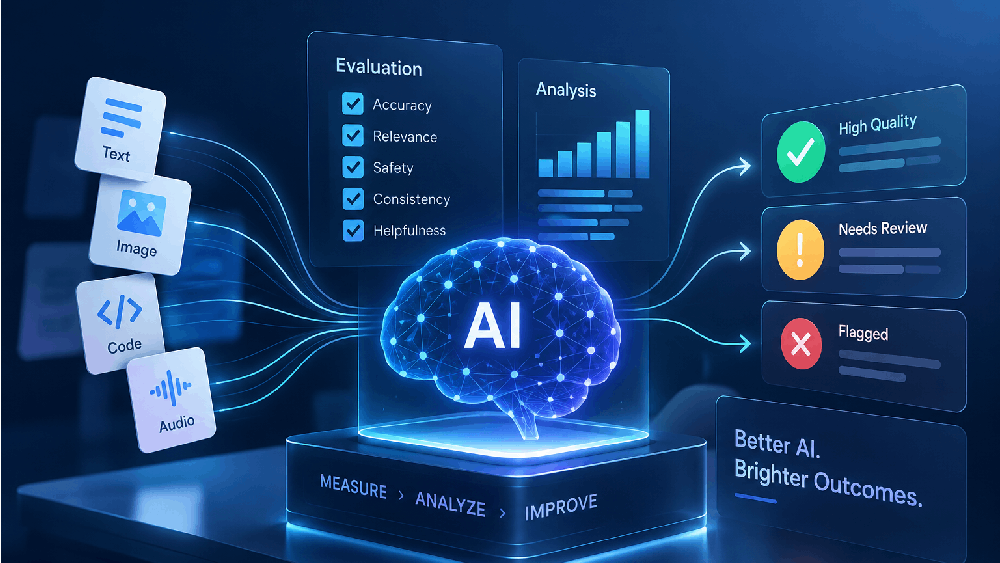

Layers map to uncertainty tolerance, not test types. Agents break the same input → same output assumption immediately.
From curated evaluation data to a regression-tested release gate a continuous path to reliable AI systems.
Build the Golden Dataset. Curate prompts and expected tool sequences that represent the evaluation use case.
Evaluate the Candidate Agent. Run the candidate agent against the curated evaluation set.
Apply LLM as Judge. Evaluate tool correctness, call order and answer relevance using explicit criteria.
Track Evaluation Signals. Monitor relevance, groundedness, tool-selection accuracy and other quality signals.
Pass / Fail the Release. Use evaluation results as a regression tested release gate before changes ship.
300+ curated prompts & expected tool sequences.
PR build runs full evaluation in CI.
Tool correctness, order accuracy, answer relevance.
PR merge gate auto-tagged in Arize.
Live signals from the evaluation pipeline before changes ever ship.
From golden datasets to regression tested evaluation gates let's make AI quality measurable and continuously improve your production systems.